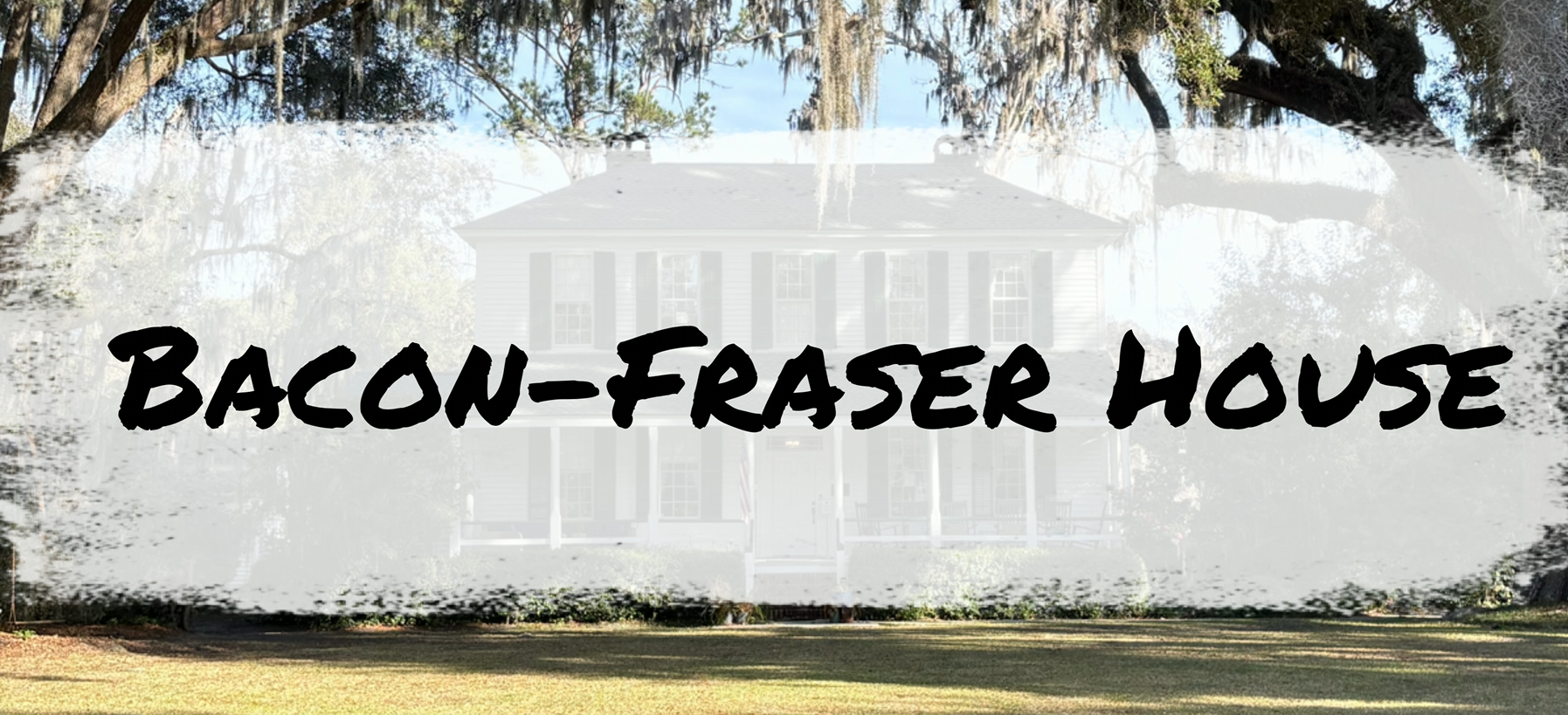
The Bacon Fraser House is a long-standing landmark in downtown Hinesville, remembered by many Liberty County locals as a historic home tucked beneath live oaks and seasonal flowers. The Liberty County Chamber of Commerce and the Liberty County Convention and Visitors Bureau purchased the property in 2017, helping preserve it as a point of welcome and community pride.
Often described as the only surviving home from Hinesville’s early settlement era that still sits on its original site, the house’s story also reaches back to earlier land history. Records note that the British Crown granted 500 acres to the heirs of Major John Martin in 1752. Much later, in 1839, Mary Jane Hazzard Bacon, the widow of Major John Bacon of Riceboro, built the home on a 23-acre tract along what was then Hinesville’s eastern boundary.
The house became closely tied to local social and civic life through the Fraser family. In 1842, Mary Hazzard Bacon’s daughter, Mary William Bacon (1825 to 1884), married Simon Fraser (1816 to 1870). They inherited the home and raised seven children there. Simon Fraser served his community in several roles, including as a deacon at Midway Church, where he taught Sunday school, as Clerk of the Superior Court, and as a member of the Georgia Legislature. Today, the house sits on about 2.6 acres in what is now downtown Hinesville, and it was added to the National Register of Historic Places in 1982.
Architecturally, the home is commonly classified as Plantation Plain, a folk building tradition found across rural Georgia and the broader Southeast during the nineteenth century. The front and the original two-story section have remained largely intact, while later changes were made with an eye toward restoring an earlier look. Additions made in 1923 were removed around 1979 to 1980 and replaced with elements designed to better match the 1839 era, including shed rooms, a porch, a dining room, and a kitchen.
The exterior is elevated on Savannah gray brick piers and features a weatherboarded, two-story, five-bay façade. Typical details include tall nine-over-nine windows with louvered shutters, a shed-roof front porch with turned columns and railing, brick entry steps, a front door topped by a transom light, a hipped roof, and two chimneys along the rear wall. Inside the original front portion, the layout follows a central hall plan with rooms on either side, along with carefully finished woodwork and period details such as hand-planed mantels, plaster cornices, ceiling medallions, curly heart pine floors, plaster walls, original hardware, and a distinctive octagonal newel post at the base of the staircase.
Local tradition also connects the house to the Civil War, telling of a moment when General Sherman’s forces passed through Liberty County and the home was spared. In that story, Mary Jane Hazzard Bacon used her husband’s Masonic apron to dissuade soldiers from burning the house, though the barn and outbuildings were not as fortunate. Beyond the structure itself, the grounds are treated as part of the site’s charm, featuring a sycamore, live oaks draped with Spanish moss, and a range of older ornamental plantings, including camellias, Confederate jasmine, azaleas, tea plants, and Banksia rose bushes.
The Bacon Fraser House is a long-standing landmark in downtown Hinesville, remembered by many Liberty County locals as a historic home tucked beneath live oaks and seasonal flowers. The Liberty County Chamber of Commerce and the Liberty County Convention and Visitors Bureau purchased the property in 2017, helping preserve it as a point of welcome and community pride.
Often described as the only surviving home from Hinesville’s early settlement era that still sits on its original site, the house’s story also reaches back to earlier land history. Records note that the British Crown granted 500 acres to the heirs of Major John Martin in 1752. Much later, in 1839, Mary Jane Hazzard Bacon, the widow of Major John Bacon of Riceboro, built the home on a 23-acre tract along what was then Hinesville’s eastern boundary.
The house became closely tied to local social and civic life through the Fraser family. In 1842, Mary Hazzard Bacon’s daughter, Mary William Bacon (1825 to 1884), married Simon Fraser (1816 to 1870). They inherited the home and raised seven children there. Simon Fraser served his community in several roles, including as a deacon at Midway Church, where he taught Sunday school, as Clerk of the Superior Court, and as a member of the Georgia Legislature. Today, the house sits on about 2.6 acres in what is now downtown Hinesville, and it was added to the National Register of Historic Places in 1982.
Architecturally, the home is commonly classified as Plantation Plain, a folk building tradition found across rural Georgia and the broader Southeast during the nineteenth century. The front and the original two-story section have remained largely intact, while later changes were made with an eye toward restoring an earlier look. Additions made in 1923 were removed around 1979 to 1980 and replaced with elements designed to better match the 1839 era, including shed rooms, a porch, a dining room, and a kitchen.
The exterior is elevated on Savannah gray brick piers and features a weatherboarded, two-story, five-bay façade. Typical details include tall nine-over-nine windows with louvered shutters, a shed-roof front porch with turned columns and railing, brick entry steps, a front door topped by a transom light, a hipped roof, and two chimneys along the rear wall. Inside the original front portion, the layout follows a central hall plan with rooms on either side, along with carefully finished woodwork and period details such as hand-planed mantels, plaster cornices, ceiling medallions, curly heart pine floors, plaster walls, original hardware, and a distinctive octagonal newel post at the base of the staircase.
Local tradition also connects the house to the Civil War, telling of a moment when General Sherman’s forces passed through Liberty County and the home was spared. In that story, Mary Jane Hazzard Bacon used her husband’s Masonic apron to dissuade soldiers from burning the house, though the barn and outbuildings were not as fortunate. Beyond the structure itself, the grounds are treated as part of the site’s charm, featuring a sycamore, live oaks draped with Spanish moss, and a range of older ornamental plantings, including camellias, Confederate jasmine, azaleas, tea plants, and Banksia rose bushes.
Here is my visit there: